 Annuaire
 Plans d'accès
 Handicap
 Vous êtes
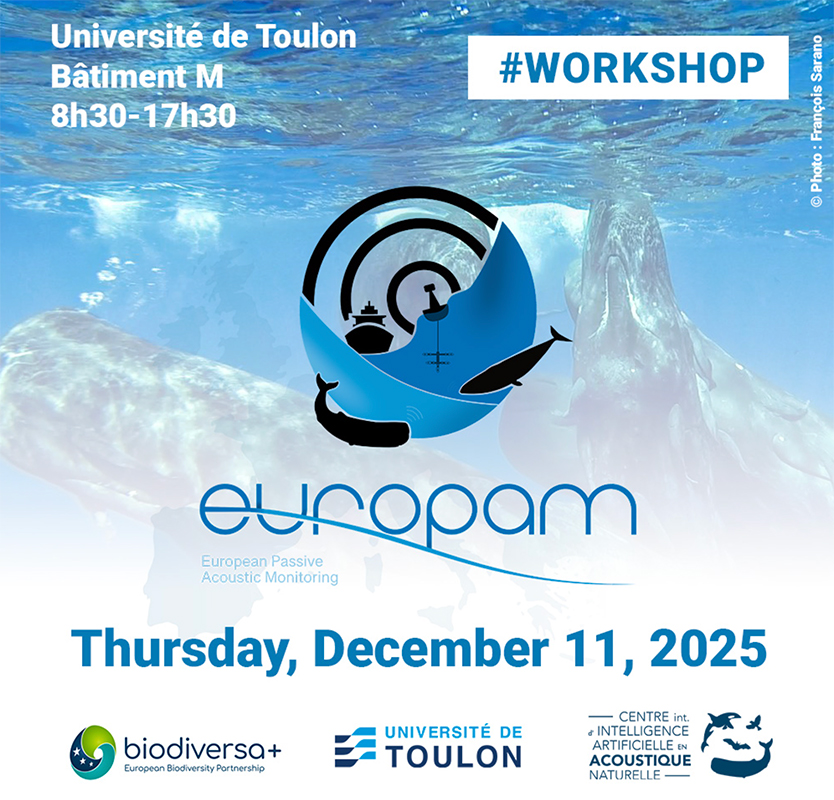
EUROPAM workshop
Jeudi 11 décembre 2025
8h30 à 17h30
Amphi 01 • Bâtiment M
Workshop ouvert à tous les étudiants et personnels intéressés.
Program
8:30 – Welcome coffee
9:00 – Introduction : aims of EUROPAM, recent missions in Medsea and Arctic and coming models (H. Glotin, PI, CIAN)
SESSION 1 : Arctic Observations and Models
9:30 – Long term acoustic monitoring of 3 superpredators in Arctic versus anthropophony (Justine Girardet, CIANLIS and CIBRA)
9:55 – Decoding echolocation : Good practices for studying the sonar of marine animals (Nicolas Deloustal, CIAN LIS)
10:15 – Sound propagation modelling validation with sound measurements from a subsea glider (Virginie Ramasco, Akvaplan-Niva)
10:40 – Propagation in Arctic Fjord (SJ to be confirmed)
11:10 – Discussions
11:35 – Break – Lunch 11:50-12-40 (Beal)
SESSION 2 : Material and Demo : Intelligent Acoustics (Sebastian Marzetti)
13:10 – 14:20 – Building compact arrays & embedded AI : Demo Coffee (Bât X)
SESSION 3 : Mediterranean and mid Atlantic observations and models :
14:35 – What can tell an array on megafauna vs anthropic pressure ? The stereo Bombyx1 (Justine Girardet, CIAN LIS and CIBRA)
14:55 – Propagation model for range estimation, perspective on megafauna localisation with in situ experiments in WW6 (Lilou Dantin, CIAN LIS & PNPC)
15:20 – SEGAMAS and transformers for UBF and HF fauna survey (Sébastien Paris, CIAN)
15:50 – Megafauna survey and ship collision risk mitigation : perspectives with the real-time BOMBYX sonobuoy in the Azores (Claudia Olivieira)
SESSION 4 : General discussion
16:15 – Megafauna-trafic collision risk and deployment of Bombyx3 (all partners, H. Glotin and PNPC)
16:45 – Next steps, collaborations and discussions
17:30 – Closure
About EUROPAM project
EUROPAM Main objectives
EUROPAM aims to increase knowledge of anthropogenic impacts on marine megafauna through large-scale passive acoustic monitoring that allows for comparison of sites and sources of disturbance, as well as the population segments of sperm whales, for example. The cornerstones for achieving the objectives will be :
- A comparative continuous passive acoustic monitoring in the Mediterranean Sea, in the Azores Atlantic Ocean, and offshore Norway, for an equivalent of 23 000 km2 ;
- A comparison of marine soundscapes from the European Arctic to the Mediterranean Sea, and from relatively quiet marine protected areas to areas under strong human activity pressure ;
- An innovative Artificial Intelligence developed to describe and model marine soundscapes and their natural patterns (daily and seasonal) that allows us to build and feed a marine soundscape repository in the cloud ;
- A strict protocol that will allow the calibration of measurements and provide comparable data across a large range of temporal and spatial scales ;
- An additional key management output of EUROPAM is mitigation of whale-ship collision risks.
Main activities
EUROPAM will identify conservation areas and seasonality of species diversity, compare noisy with quiet areas, and measure noise level changes in relation to wind farm construction, new industrial offshore development and the exponentially increasing marine traffic. The project will monitor the Arctic, Atlantic, and Mediterranean Sea regions, which are all expected to be highly impacted by climate change. It addresses the topics highlighted in Theme 1 of this call, by establishing a
comprehensive understanding of effective and resilient ecological networks, while contributing to enhanced species-based protection.
Furthermore, the project will monitor exponentially increased marine traffic and observe species displacement, while comparing acoustics of across latitude gradients (between Mediterranean Sea, Azores and Norway) using state-of-the-art methodology. Europam has wide ranging applications and benefits. It is a cross-cutting subject with economic, social and political impacts. A preliminary stakeholder analysis has been conducted to identify key actors that will be actively involved in the project through outreach activities, like Knowledge Transfer Workshops.